
The Moment Students Realised What Future Skills Really Mean
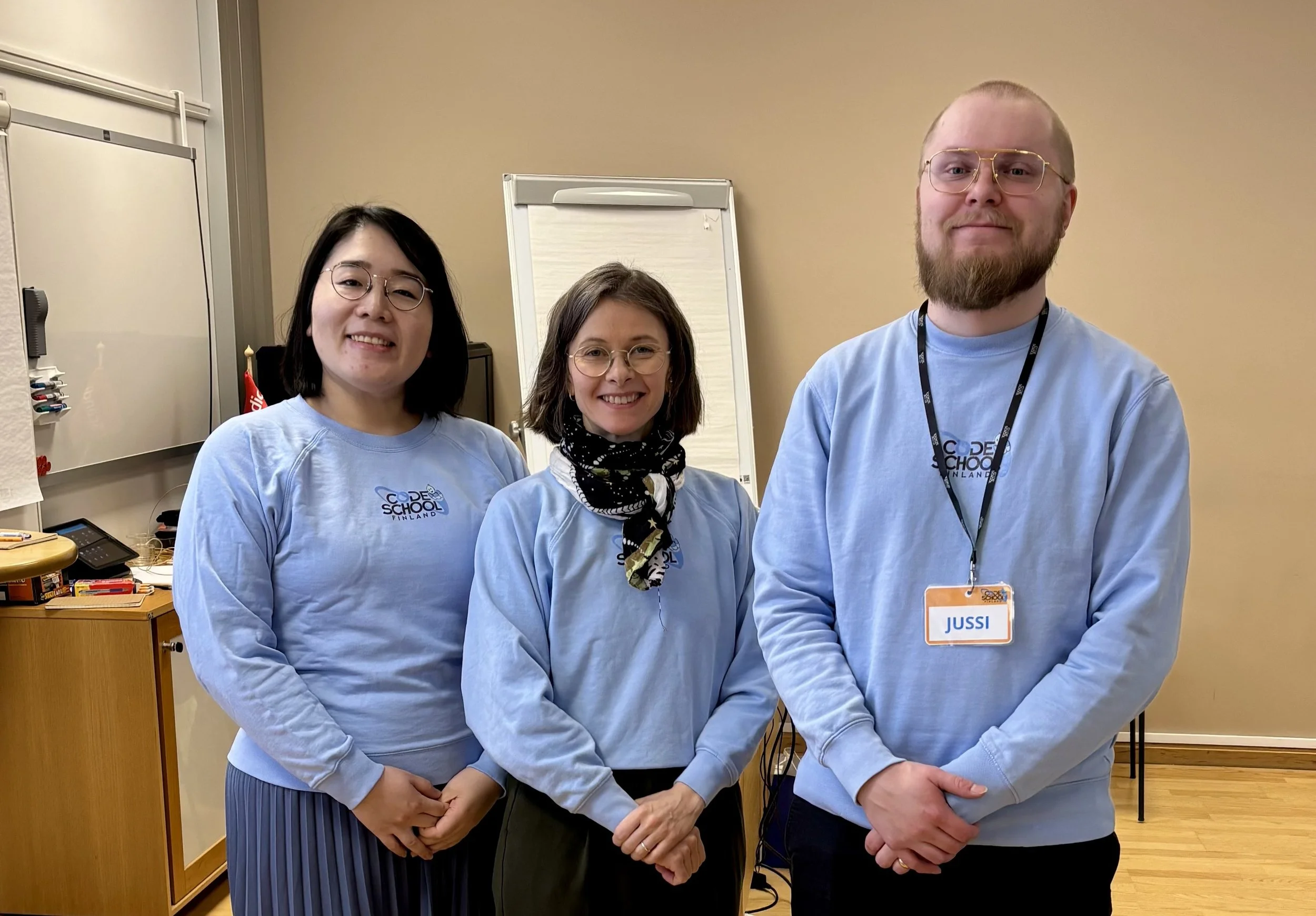
The coaching team behind the camp: Fumika, Sirkku and Jussi.
During our recent Future Skills camp with 60 high school students from Japan and Finland, something interesting happened.
Of course, students do not become advanced programmers in five days. Their English does not suddenly improve either. But something else started to change.
As the week progressed, many students began to see more clearly what these kinds of skills are actually about. Digital skills, collaboration and communication are not separate things. When students work on real problems, they quickly become connected.
When teams were debugging their code and presenting their ideas, it became clear that technology work is rarely something you do alone. Progress depended on explaining ideas, asking for help and working together with people from another country.
So the students were not only learning Python or basic AI concepts. They were also experiencing how technology is used in practice: through teamwork, problem solving and communication.
This kind of shift does not happen by accident. It comes from careful planning and from having the right coaching team supporting the students throughout the week.
Behind the scenes
When hosting 60 high school students from Japan and Finland for an intensive five-day camp, you quickly realise that while the curriculum focuses on Python and AI, the success of the week depends on something far more human.
Following up on our recent post, More than AI, I wanted to share a coach’s perspective on how we organised such a large international learning experience.
At Code School Finland we have extensive experience in hosting international camps. But expertise in this context means more than teaching coding. It means understanding how students learn in international environments and designing the right support structures.
For this camp, we worked as a team of three coaches: two from Finland and one from Japan. Each coach had a clearly defined role.
The technical anchor
My Finnish colleague Jussi focused on the technical side of the camp. He worked closely with students when they encountered programming challenges, helping them troubleshoot bugs and understand the logic behind their code. This ensured that project work kept moving forward.
The cultural and linguistic bridge
Our Japanese colleague Fumika played a crucial role as a cultural and linguistic bridge. Many Japanese students were initially hesitant about their English skills, so she helped ensure that everyone understood the tasks and felt confident participating. She also supported communication within the mixed teams
The coordinator
My role was to coordinate the overall flow of the camp. I managed the daily schedule, morning warm-ups, communication with the Japanese school, and many of the practical details that keep a group of 60 students moving smoothly through a busy week.
Creating a safe environment for learning
In international education, language differences can easily become a barrier to participation. By clearly dividing our roles and supporting students from different angles, we created a learning environment where students felt safe experimenting, asking questions and sharing ideas.
This allowed students to focus on learning rather than worrying about making mistakes.
As the week progressed, the teams became more confident not only in their coding but also in discussing ideas, presenting projects and helping each other solve problems.
Why learning design matters
At Code School Finland, we believe that teaching future skills requires more than teaching technology. It requires carefully designed learning experiences.
By combining Finnish pedagogy with cultural support and structured teamwork, we create environments where students can develop technical skills, AI literacy and collaboration skills at the same time.
Watching 60 students receive their certificates at the end of the week, many of them proudly standing with teammates from another country, was a powerful reminder of why these experiences matter.
We are not only teaching coding. We are helping students build the confidence and skills they need to participate in a global technology community.
Interested in creating a meaningful learning experience in Finland?
If you are planning a student learning camp, AI and coding camp, or an international workshop, we would be happy to design it together with you.
Get in touch:
Sirkku Tahvanainen
Head of Education
sirkku@codeschool.fi